2019 - 2020
Baseline and Pre-Acceleration
Programming-heavy and review-heavy tracks are established as the pre-AI baseline.
Story Context
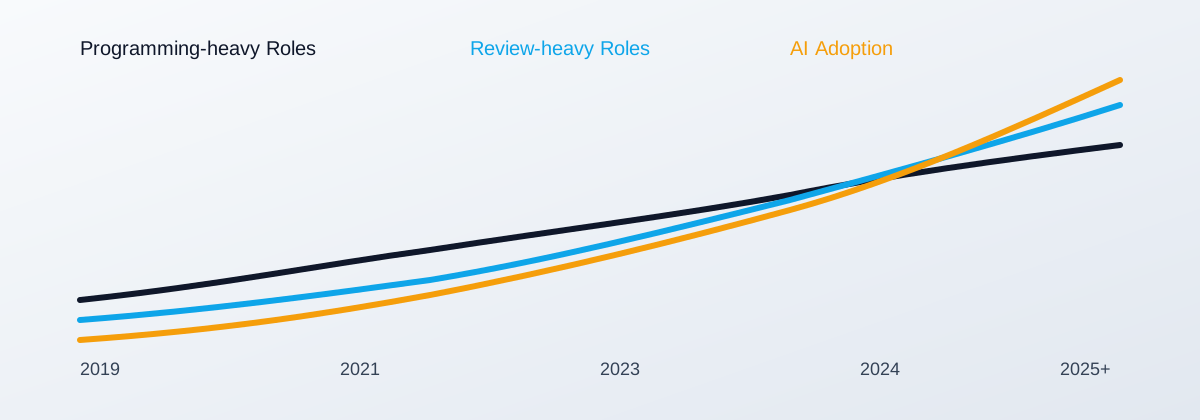
Software teams are navigating a practical question: is AI reducing the need for programmers, or redistributing work toward reviewers and validators? This project frames that question as a measurable story across labor, adoption, output, and security signals.
Background Context
The narrative starts with a workforce question, moves through evidence and segmentation, and ends with practical takeaways. Each section below maps to one step in that reasoning path.
TypeScript-first Next.js setup with strict tooling and standards.
Normalized real-world signals with API and MCP integration.
Responsive storytelling shell with timeline navigation and progress tracking.
Interactive comparisons and filterable trend evidence.
Natural-language assistant grounded in MCP-backed dataset responses.
Evidence Layer
These metrics define the evidence baseline: role demand movement, AI adoption, output pressure, and risk.
Programming Roles Index
Tracks code-authoring demand trend over time.
Reviewing Roles Index
Tracks QA, review, validation, and oversight signals.
AI Tool Adoption
Normalizes AI workflow adoption rate across data sources.
Timeline Structure
2019 - 2020
Programming-heavy and review-heavy tracks are established as the pre-AI baseline.
2021 - 2022
AI-assisted tooling starts appearing in mainstream workflow narratives and team process changes.
2023 - 2024
Validation, governance, and quality-control responsibilities expand in parallel with generation tools.
2025+
Projected trendline emphasizes architects, reviewers, and security gatekeepers for AI-generated output.
Segmentation and Counterpoints
Filter by timeframe, region, company size, and role bucket to test where the role-shift pattern holds and where it weakens. This prevents single-number conclusions from masking segment differences.
AI Chat Interface
Ask natural-language questions and receive answers grounded in project data, including tool selection, confidence score, and source citations.
FAQ and Educational Guidance
Browse practical guidance for jobs, skills, security, and future roles with direct links back to evidence in this project.
Conclusion and Takeaways
The data currently supports a transition toward oversight-heavy engineering workflows, with meaningful variation across segments and clear limits on causal certainty.
The strongest signal is role rebalancing. Teams still need coding, but review and validation responsibilities are expanding faster.
Region, company size, and role-bucket filters show that not every segment shifts at the same pace, so conclusions should stay segmented.
Developers who combine implementation with testing, security review, and AI-output governance are better aligned with emerging demand.
Source Transparency
Every API and MCP response carries provenance metadata so UI claims can be traced back to specific source IDs.
Sprint 5 Data Visualization
Explore role-shift metrics with filters, chart switching, and export controls.
Role filters
Chart view and export
Data table fallback (accessibility)
| Period | Programming | Reviewing | Code Volume | Vuln / KLOC | AI % |
|---|
Sprint 6 AI Chat
Ask about trends, regions, roles, exports, or sources.
Prompt content may be processed by model providers and server logs for reliability and abuse prevention.
Start a conversation with one of the suggestions below or type your own prompt.
Sprint 7 FAQ & Learning
Practical answers based on project data for students, developers, and managers.
Category
Our dataset shows a shift in task mix, not a full removal of software roles. Programming-heavy work still exists, but review-heavy and validation work grows as AI adoption increases. Roles tied to testing, security checks, and output verification are becoming more central.
Sources: stack_overflow, github_innovation_graph, bls_oews
Yes. Coding remains necessary, but expectations are changing. Teams increasingly need developers who can read, review, and improve AI-generated code. Strong fundamentals in architecture, debugging, and quality engineering now matter more than raw typing speed.
Sources: stack_overflow, github_innovation_graph
AI-generated code can speed development, but it still requires structured security review. Our vulnerability and review indicators support a practical conclusion: security risk depends on review quality, not only on who or what wrote the first draft.
Sources: nvd_cve, github_innovation_graph
The strongest growth pattern appears in roles that combine software engineering with governance: AI workflow reviewers, prompt and tooling integrators, security-focused reviewers, and engineers who validate model-assisted outputs against product and compliance requirements.
Sources: bls_oews, stack_overflow, github_innovation_graph
Focus on three habits: (1) build stronger review and testing workflows, (2) learn how to evaluate AI output quality and security, and (3) communicate findings using evidence from data. Developers who can pair coding with judgment and validation are in the strongest position.
Sources: stack_overflow, nvd_cve
Teams should not remove junior pathways. The safer approach is to redesign them. Junior developers can start with testing, review checklists, and AI-output verification while still learning core programming foundations.
Sources: bls_oews, stack_overflow
Treat AI outputs as drafts, not final code. Keep strong debugging practice, test-first habits, and manual review checkpoints. The goal is to increase throughput without losing core engineering judgment.
Sources: stack_overflow, github_innovation_graph
The project data suggests teams reward developers who combine coding with validation and system-level thinking. Building AI fluency can improve mobility, but long-term value still depends on reliable delivery, security, and collaboration.
Sources: stack_overflow, bls_oews, github_innovation_graph
Search is instant and category filters apply in real time.